 Paper
Paper Code
CodeAction oscillation in deep RL
Deep RL policies can produce nonsmooth action oscillations that hinder deployment on physical robots. Reducing these oscillations calls for two policy properties: temporal smoothness, low policy sensitivity to state inputs received over time, and spatial smoothness, low policy sensitivity to small input changes caused by observation noise.
Limitations of Spatial Regularization
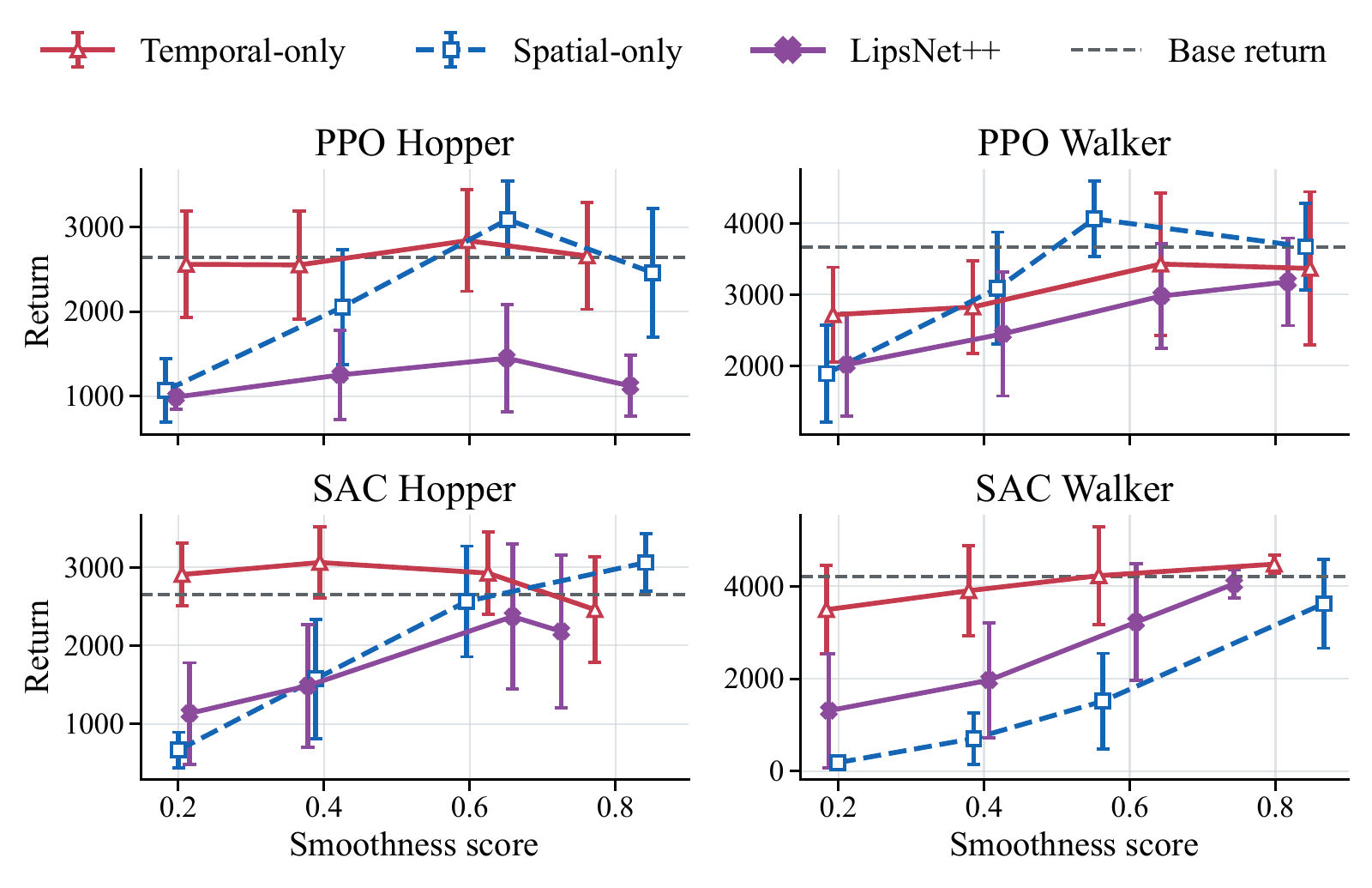
Although action oscillation is fundamentally a change in policy outputs over time, many existing methods seek smoothness across the state space without considering the temporal ordering of inputs. While they can promote spatial smoothness, their broad constraints may also restrict action changes needed for high return.
Spatial regularization
Revisiting temporal regularization
Temporal regularization
Induced spatial smoothness
vs. Spatial Regularization (Matched Smoothness)
Spatial smoothness without a spatial penalty
(Lower sensitivity indicates better spatial smoothness.)
Evaluated at σ = 0, 0.05, 0.1, 0.15, 0.2, 0.25, 0.3, 0.4, 0.5, 0.6, 0.7, 0.8, 0.9, and 1.0.
Under observation noise
Smooth control after sim-to-real transfer
Main view
Additional view
On real-world Reach, PPO's abrupt movements prevented the end effector from remaining near the target, reducing task performance. In contrast, CATS better preserved task performance while maintaining smooth control. We recorded an additional camera view to show PPO's small but persistent oscillations more clearly.
Conclusion
Our findings show that temporal regularization can provide both temporal and spatial smoothness while better preserving return under strong smoothing. More broadly, these findings motivate designing smoothness regularization around transition directions relevant to control, avoiding unnecessary constraints on action changes needed for task performance. Linear ramp-up complements this direction by allowing the policy to learn rewarding behavior before smoothing its actions, rather than seeking rewarding behavior under smoothness constraints. CATS demonstrates the practical value of these findings through smooth control in simulation and on a physical robot with little additional complexity.
BibTeX
@misc{ahn2026cats,
  title         = {Revisiting Temporal Regularization for Smooth Control in Deep Reinforcement Learning},
  author        = {SungJae Ahn and Jeong Woon Lee and Kyoleen Kwak and Hyoseok Hwang},
  year          = {2026},
  eprint        = {2610.07910},
  archivePrefix = {arXiv},
  primaryClass  = {cs.LG},
  url           = {https://arxiv.org/abs/2610.07910}
}