SungJae (Daniel) Ahn

I'm an undergraduate student at KyungHee University majoring in Computer Science and Engineering. I'm an undergraduate researcher at KHU AIRLab, advised by Prof. HyoSeok Hwang. My research interests include Reinforcement Learning, Continual RL, and Meta RL.
Research
I believe that achieving AGI requires learning
paradigms that enable agents to adapt and improve through
autonomous
experience, much like
Reinforcement Learning (RL).
In particular, I am interested in Continual RL and Meta RL, which aim to enable agents to learn reusable knowledge from their histories and apply it to new environments, potentially improving the sample efficiency of RL algorithms.
Recently, I have become interested in learning intrinsic rewards online to enable agents to explore rationally and adapt to changing environments. |
Publications |
|
|
Revisiting Temporal Regularization for Smooth Control in Deep Reinforcement Learning
SungJae Ahn, Jeong Woon Lee, Kyoleen Kwak, Hyoseok Hwang Submitted to ICRA 2027 project page / paper / code In this work, we show that the temporal penalty, previously considered unrelated to spatial smoothness, can in fact induce this very property through shared next states, improving robustness to observation noise. Our extensive experiments show that, by avoiding direct spatial regularization, CATS can achieve both forms of smoothness while better preserving task performance. |
|
Projects |
|

|
Mental Model Research for Robot Learning and Reasoning
Korea Institute of Science and Technology (KIST), Ongoing This project aims to integrate a mental model into a vision-language-action (VLA) model to interpret the scene and task progress, infer the next subtask, and generate consistent behavior in long-horizon manipulation tasks. |
|
Analyzing Reasoning Diversity in Self-Distillation
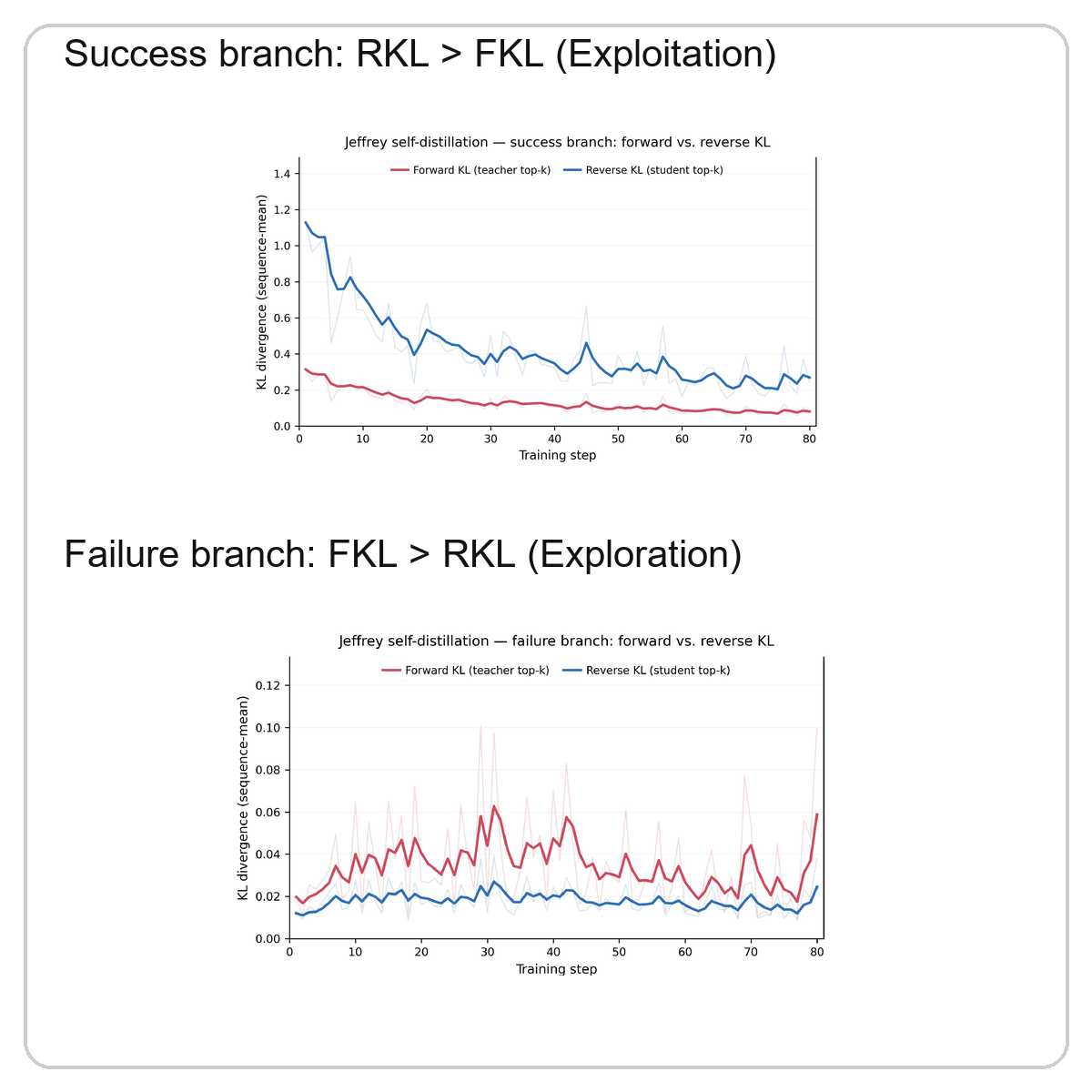
Advanced Deep Learning, Spring 2026 presentation SDPO uses a single successful rollout to supervise others, explicitly reinforcing a narrow set of reasoning strategies. We demonstrated that utilizing only text feedback from failed rollouts can encourage diverse strategies. We also found that, together with SDPO's top-K approximation, the direction of KL divergence has different effects depending on the outcome. For example, when the student fails, the reverse KL used by SDPO provides a weaker learning signal than forward KL for selecting new words because the student already assigns low probability to promising tokens. |
|
|
Website template from Jon Barron. |